
In order to become proficient in judo throws, be it for sport or for self-defense, it is of the utmost importance to understand the concepts behind the throws. There are very necessary concepts or elements to a judo throw. Understanding these concepts and how they impact a particular technique, you can improve your performance.
First and foremost, a judo throw requires the establishment
of a strong grip. An offensive gripping strategy can help keep the opponent or
adversary on their heels both literally and figuratively. Not having a solid
plan for your grips can leave you vulnerable and at the mercy of your opponent.
The second concept is off-balancing the opponent or
adversary. The best judo throws often look of almost effortless and your
opponent/adversary doesn't even realize what has just happened. Though no techniques are actually effortless,
being able to effectively off balance the opponent can make a technique appear
to be so. If the off balancing is not present the throw will not be successful.
The next step is getting into position to do the throw. Once
you get your opponent off-balance, the next step is to get yourself into
position for the throw. This must be executed as a coordinated and fluid
movement. This requires speed as well as not releasing the pressure that keeps
your opponent off-balance.
Then there is the execution of the throw. The most effective
throwing movements are performed in an explosive manner. The simultaneous and
explosive movement of the different parts of the body in a coordinated way
allows for greater speed and force, which will end in a successful and
effective throw.
.jpg)
You can off balance your opponent by pushing, pulling on his
clothes and arms, bump or crash into him and striking. Stepping in and striking
his shoulders with either one or both of your hands. Crashing into him with
your elbows or shoulders is an excellent means of disrupting his balance. The
objective is to take over/occupy and destroy the opponent’s center line while
you maintain a good athletic posture.
Picture your opponent standing square with you. Now imagine
a rectangle imposed on the opponent’s body. The two top corners of the
rectangle are at both of his shoulders (Upper Quadrant) the two bottom corners
are at both of his feet (Lower Quadrant). Look at all four of the corners as
the legs of a table, disrupt one and the table is primed to fall. Attacking any
of the corners with hard strikes effectively disrupts the aggressors balance
and posture.
Getting the head beyond the plane of the feet (Lower
quadrant) by pushing, pulling or striking in any direction is an extremely
effective point of disruption.
Punching in the grip
.jpg) |
| Blue looking like a boxer, parries White's grip attempt with his left hand and punches in his grip. |
There is a strategy in judo. ”First grip. First attack. Finish.” Some elite level Judo players often “punch in” their grips like a boxer throwing a punch, jab cross, uppercut etc. (Modern Olympic judo competitors look almost like boxers, circling each other while jabbing and probing their opponent's defenses, punching their hands in for a perfect grip. The perfect grip being the one that allows one to immediately initiate a successful throw or takedown.) This concept blends in nicely with any striking combinations and can be interjected into your combination without any disruption of flow. Meaning any punch or check that you execute can conceivably also be a throw.
It can be utilized very effectively at long or medium ranges and even pre-emptively. As a preemptive technique, just before the attacker gets within striking distance. It can also be used when the attack is picked up early and done to intercept an incoming strike. Most importantly it can disrupt an attacker’s balance, rocking him back on his heels or affect his posture forcing him out of a good athletic position.
The lead in for the entry can be executed with either foot stepping forward while striking either one of the shoulders. An added benefit is that it has the potential to stop the rotation of the attacker’s torso at his shoulder, basically short-circuiting the power of the attacker’s incoming punch at the root of its motion. This one-handed style of entering into judo throws is very effective and allows for great adaptability and the ability to execute various throws from multiple angles and directions. You can step directly you’re your opponent or off line to create various angles.
Being able to throw with either foot forward as well as
having the ability to throw to both the right and left side leaves your
opponent questioning from which direction you will attack. Pictured below is a
example of punching in the grip in a judo situation followed with an example
for possible use in the system of Kajukenbo.
.jpg)
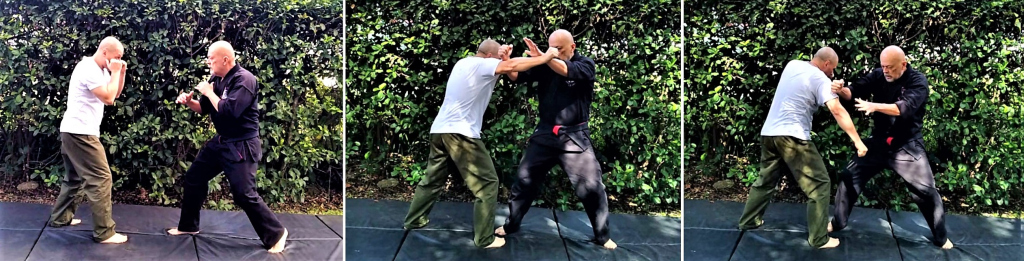
1.) Judoka in white is standing in a right foot forward
lead stance. The judoka on the right is in a false lead stance with knees bent
and center of gravity low. His feet are shoulder width apart. He turns his
upper body clockwise bringing his left hand and shoulder to the front closer to
the opponent. The left hand is the attacking hand and is positioned closer to
his opponent. The right hand acts as the defensive hand. 2.) Much like
delivering a straight punch in boxing, punch in with left hand and grip your
opponent’s gi right above the armpit at the pocket of the shoulder. 3.) Both
are standing in a right foot forward lead stance. 4.) Push off the rear foot
and step forward toward one o’clock with the right foot. Simultaneously punch
the grip in striking the opponent at the pocket of the shoulder with an open
hand hard “check”. This check should be hard and ballistic enough to rock the
opponent back onto his heels and disrupting or breaking his fighting posture.
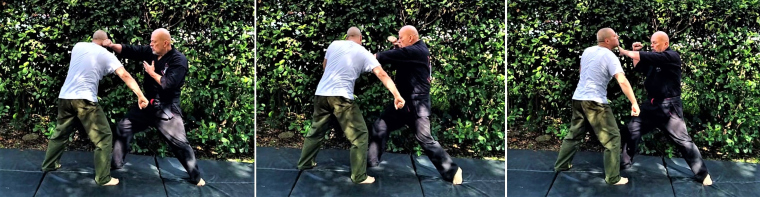
NOTE: In setting up your throw you want to
create a whiplash effect by striking the shoulder with enough force to rock him
back on his heels and then suddenly jerking him forward to bring him up on the
balls of his feet and to his front. When rocked back on his heels he will
automatically and instinctively try to correct his posture. He may either take
a step backward or try and lean forward to retain his balance. A sudden quick
jerk toward you will cause him to rock forward onto his toes.
OSOTO GARI – Major Outside Reap
.jpg)
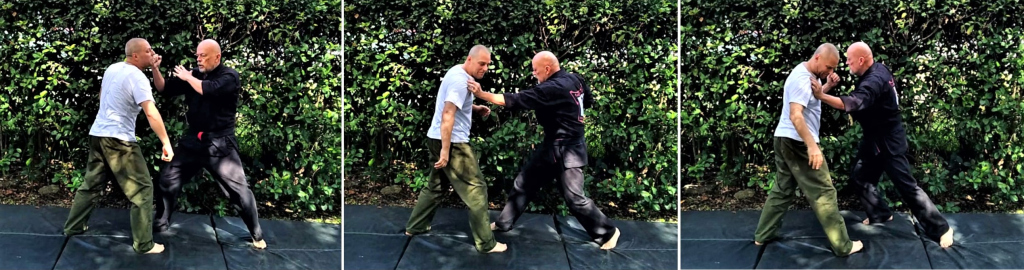
1.) From a right foot forward fighting stance or non-violent posture. 2.) Push off the left foot and step in with the right foot shuffle forward to twelve o’clock and STRIKE your opponent’s right shoulder hitting with a straight left heel of palm strike rocking the opponent backwards. Upon impact immediately grab the clothing with your left hand at the area struck.
(Notice that upon impact the opponent’s lead foot is
off the ground. The STRIKE to your opponent’s shoulder should be delivered hard
enough to knock the opponent off balance, rocking him back on his heels and
disrupt his posture.)
3.) Push off the right foot stepping forward with your
left foot to the outside of the opponent’s right foot toward eleven o’clock. Immediately
pull with your left hand as you step to eleven o’clock with your left foot. Your
weight shifts to the left leg and maintaining the hold on his shoulder and your
right hand under hooks and grabs his right arm at the triceps. Pull the front
of his right shoulder hard into your chest. (The pulling actions break his
balance to his right leg.)
.jpg)
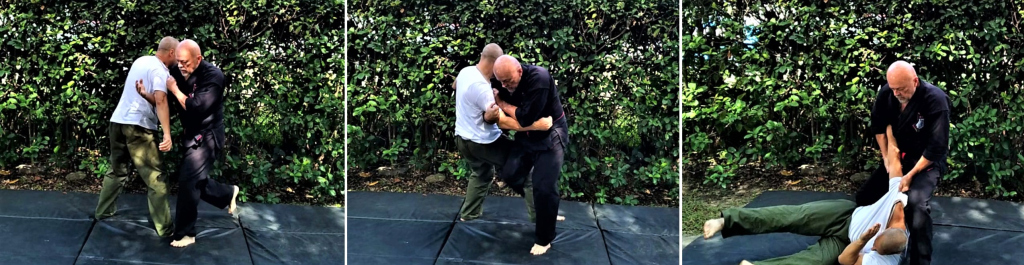
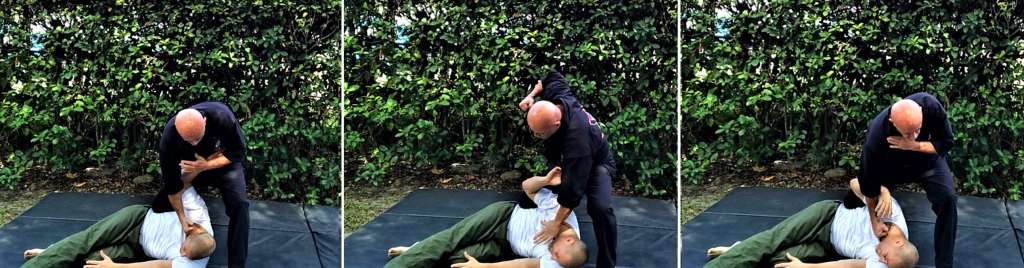
4.) Pulling with your left hand bring your right knee forward and up in between your left leg and the outside of your opponent’s right leg. Your right thigh should be raised until it is parallel with the ground. 5.) Swing your right leg downward and back without letting your right foot touch the ground. The back of your calf should make contact with the back of your opponent’s calf. Continue your pull with your left hand bringing your left elbow to your left hip. 6.) Continue with the sweep taking your opponent’s leg upward. Sweep his leg high. While sweeping your opponent’s leg drive his shoulder downward to the ground by continuing to pull your left elbow to your left hip.
(To do the takedown to the opposite side substitute the word “left” for “right” and “right” for “left”.)

.jpg)
.jpg)
.jpg)
.jpg)
.jpg)
.jpg)
.jpg)

.jpg)
.jpg)
.jpg)
.jpg)
.jpg)
.jpg)

.jpg)
.jpg)
.jpg)
.jpg)
.jpg)
.jpg)
.jpg)
.jpg)