© COPYRIGHT – ALL RIGHTS RESERVED. This site is protected and monitored by DMCA.COM - ANY UNAUTHORIZED Reproduction, Duplication, Distribution of any kind is STRICTLY PROHIBITED. All original content is created by the website owner, Barron Shepherd/Kajukenbo Tactical Fighting Method - KTFM , including but not limited to text, design, code, images, photographs and videos are considered to be the Intellectual Property of the website owner, Barron Shepherd/KTFM, whether copyrighted or not, and are protected by DMCA Protection Services using the Digital Millennium Copyright Act Title 17 Chapter 512 (c)(3). Direct linking, reproduction or re-publication of this content is prohibited without permission. Under 17 U.S.C section 101 et seq. those who violate the DMCA could be liable for statutory damages as high as 150,000.00 as set forth in section 504(c)(2) therein.

Saturday, November 9, 2024

KAJUKENBO: Drilling Combinations Builds A Stronger Foundation

Kajukenbo is a hybrid fighting system specifically designed for real world combat. Kajukenbo encompasses the precision strikes of karate, the powerful throws of judo, the fluid movements of kenpo and the raw power of boxing all combined into a single unstoppable force. Training in Kajukenbo is an intense endeavor. Practitioners develop striking techniques that can incapacitate opponents with rapid fire speed and precision. High level Judo throws have been incorporated in my personal method of Kajukenbo. These variations can be utilized to hit throws with more versatility and effectively from many more angles than the more conventional variations of throws. 

The goal in Kajukenbo is to seamlessly transition between striking, throwing and grappling in combinations. These combinations are important because they increase the odds of landing your strikes and setting up your throws. When you throw punches in combinations, your opponent has to deal with attacks from different angles, making it more likely that some of your punches will land as well as create opening s to enter into throws. 

It also makes it harder for your opponent to counterattack. When you attack or counter in combinations, your opponent has to deal with attacks coming from all directions, making it harder for them to counterattack. By changing the angles of your techniques and attacks, you can keep your opponent guessing about what combination you'll throw next and create more opportunity to incorporate hitting someone with the good old planet earth. 

Throwing a few combinations in a row can help you feel more confident and establish dominance. Couple this with the fact that hitting a judo throw in the ring or in a fight sends the message loud and clear that this person is highly skilled at what they do. 

Drilling combinations is important because it helps you build a strong foundation. A strong foundation includes learning the foundational strikes and throws, moving in all directions, and evasive maneuvers. Drilling combinations helps you develop the building blocks of technique that you can use to create and develop effective techniques. It also helps you perform in any situation. A successful combination is one where you can land your shots, protect yourself, get out of your opponent's reach but most importantly overwhelm the attacker. Lastly it helps you perform when the pressure is high.

In Kenpo Karate there are what has come to be known as the Master Keys. MASTER KEY MOVEMENT(S) are defined as being a move or series of moves that can be used in more than one predicament with equal effect. MASTER KEY TECHNIQUES entail sequential arrangements of movements (combinations) that can be applied to a number of predicaments. The concept and art of Master Key Techniques is to eventually be able to use any and all techniques as a BASE MOVE and to see how all other techniques are formulations of it. This should lead you not only to the next technique but to the next level of spontaneity. 

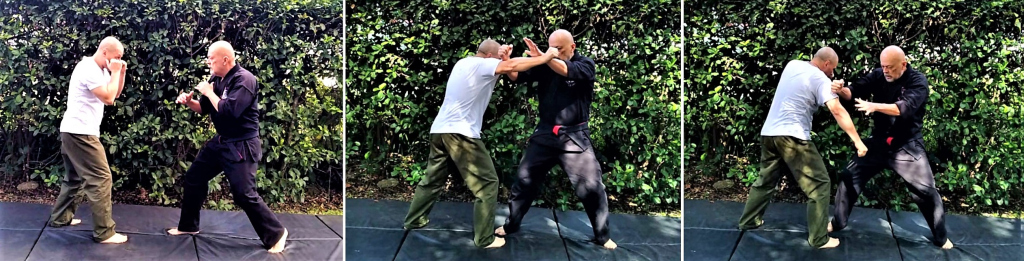
In the case of a MASTER KEY TECHNIQUE it is a single technique that may be used as a BASE MOVE. Other similar techniques may then be perceived as formulations of it. As an example the below combination ends with the step pivot variation of Ippon Seoi (shoulder throw) however other formulations of the shoulder throw can be interjected, IE the split step entry or the back step entry, see previous previous article HERE.

1.) The opponent is standing in a right side forward fighting stance and the defender is standing in a right forward lead.   2.) The opponent throws a left round house punch.  Push off the rear foot and step forward with your right foot shuffling forward. Block the incoming punch with a right outward Hammering block. Your left hand comes up covering the right side of your face and head.   3.) The defender pivots counter clockwise simultaneously bending at the knees and dropping his hips and striking the opponent’s right arm with a right downward hammer fist.

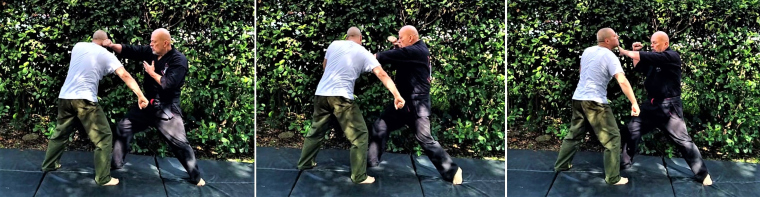
4.) From the exact point of contact of the downward hammer fist to the opponent’s right arm, pivot back clockwise on both feet and execute a right hammer fist to the opponent’s jaw or side of neck. Your left hand remains chambered at your right shoulder.   5.) Immediately pivot clockwise as if corkscrewing yourself into the ground and execute a left corkscrew punch to the side of the opponent’s jaw. Your right hand rechambers at your chin.   6.) Shown at a slightly different angle, your hips and shoulders torque back pivoting slightly back counter clockwise as you strike with a right shovel punch to the opponent’s body. You left hand rechambers at your right shoulder.

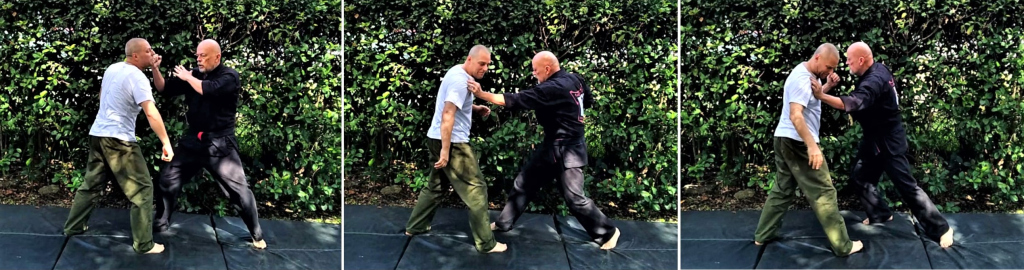
7.) Push off the rear foot raising the heel off the ground as you strike the left side of the opponent’s neck with the outward boney area of the forearm. Your right hand chambers at your chin.   8.) Immediately, execute a right punch as your feet shift position. Your right foot shuffles back and pivots counter clockwise as the left foot moves forward toward the direction of the ten o’clock position. Follow through with the punch by turning your hand over.   9.) Step your right foot forward toward the twelve o’clock position and bring your left foot moves back toward the seven o’clock position and pivot counter clockwise toward nine o'clock. The knees bend and your hips drop as you an execute a right downward hammer fist to the groin.

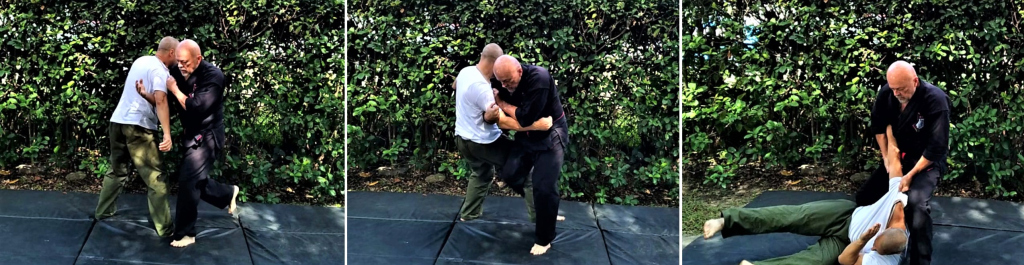
10.) Immediately contour up the opponent's body and deliver a right vertical elbow under the opponent's chin.   11.) Pivot on both feet clockwise toward twelve o'clock and strike your opponent’s right shoulder with a left heel of palm strike and grab his clothing at the area struck. This strike should be hard enough to disrupt his posture and rock him back on his heels.   12.) With a short quick jerk, pull him into you. This should rock him to his front and off of his heels. Simultaneously step your right foot straight to the inside of his right foot.

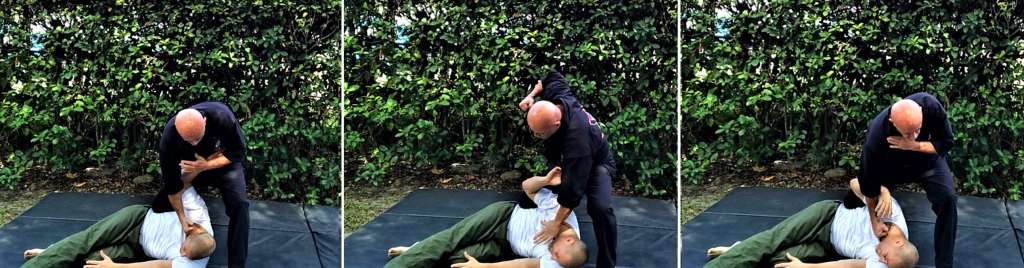
13.) Pivot on your right foot counter – clockwise and bring your left foot back between your opponent’s feet. Simultaneously pull the opponent forward and bring your right arm up under his right arm. Pinch his right bicep between your right bicep and forearm.   14.) Straighten your legs and bend at the waist popping your hips up and lifting him into the air (this is an explosive movement).   15.) Keeping your grip on the opponent, bring your left elbow downward, twisting your upper body toward your left hip to finish the throw.   


              CLICK IMAGE TO

    ORDER DYNAMIC KAJUKENBO 

     29.95 USD plus Shipping
    SHIPS IN UNITED STATES ONLY

Thursday, December 28, 2023

KAJUKENBO: Necessary Concepts for Effective Judo Throws

In order to become proficient in judo throws, be it for sport or for self-defense, it is of the utmost importance to understand the concepts behind the throws. There are very necessary concepts or elements to a judo throw. Understanding these concepts and how they impact a particular technique, you can improve your performance.

First and foremost, a judo throw requires the establishment of a strong grip. An offensive gripping strategy can help keep the opponent or adversary on their heels both literally and figuratively. Not having a solid plan for your grips can leave you vulnerable and at the mercy of your opponent.

The second concept is off-balancing the opponent or adversary. The best judo throws often look of almost effortless and your opponent/adversary doesn't even realize what has just happened.  Though no techniques are actually effortless, being able to effectively off balance the opponent can make a technique appear to be so. If the off balancing is not present the throw will not be successful.

The next step is getting into position to do the throw. Once you get your opponent off-balance, the next step is to get yourself into position for the throw. This must be executed as a coordinated and fluid movement. This requires speed as well as not releasing the pressure that keeps your opponent off-balance.

Then there is the execution of the throw. The most effective throwing movements are performed in an explosive manner. The simultaneous and explosive movement of the different parts of the body in a coordinated way allows for greater speed and force, which will end in a successful and effective throw.


Off Balancing


You can off balance your opponent by pushing, pulling on his clothes and arms, bump or crash into him and striking. Stepping in and striking his shoulders with either one or both of your hands. Crashing into him with your elbows or shoulders is an excellent means of disrupting his balance. The objective is to take over/occupy and destroy the opponent’s center line while you maintain a good athletic posture.

Picture your opponent standing square with you. Now imagine a rectangle imposed on the opponent’s body. The two top corners of the rectangle are at both of his shoulders (Upper Quadrant) the two bottom corners are at both of his feet (Lower Quadrant). Look at all four of the corners as the legs of a table, disrupt one and the table is primed to fall. Attacking any of the corners with hard strikes effectively disrupts the aggressors balance and posture.

Getting the head beyond the plane of the feet (Lower quadrant) by pushing, pulling or striking in any direction is an extremely effective point of disruption.


Punching in the grip

Blue looking like a boxer, parries White's grip attempt with his left hand and punches in his grip.

There is a strategy in judo. ”First grip. First attack. Finish.” Some elite level Judo players often “punch in” their grips like a boxer throwing a punch, jab cross, uppercut etc. (Modern Olympic judo competitors look almost like boxers, circling each other while jabbing and probing their opponent's defenses, punching their hands in for a perfect grip. The perfect grip being the one that allows one to immediately initiate a successful throw or takedown.) This concept blends in nicely with any striking combinations and can be interjected into your combination without any disruption of flow. Meaning any punch or check that you execute can conceivably also be a throw.

It can be utilized very effectively at long or medium ranges and even pre-emptively. As a preemptive technique, just before the attacker gets within striking distance. It can also be used when the attack is picked up early and done to intercept an incoming strike. Most importantly it can disrupt an attacker’s balance, rocking him back on his heels or affect his posture forcing him out of a good athletic position.

The lead in for the entry can be executed with either foot stepping forward while striking either one of the shoulders. An added benefit is that it has the potential to stop the rotation of the attacker’s torso at his shoulder, basically short-circuiting the power of the attacker’s incoming punch at the root of its motion. This one-handed style of entering into judo throws is very effective and allows for great adaptability and the ability to execute various throws from multiple angles and directions. You can step directly you’re your opponent or off line to create various angles.

Being able to throw with either foot forward as well as having the ability to throw to both the right and left side leaves your opponent questioning from which direction you will attack. Pictured below is a example of punching in the grip in a judo situation followed with an example for possible use in the system of Kajukenbo.


1.) Judoka in white is standing in a right foot forward lead stance. The judoka on the right is in a false lead stance with knees bent and center of gravity low. His feet are shoulder width apart. He turns his upper body clockwise bringing his left hand and shoulder to the front closer to the opponent. The left hand is the attacking hand and is positioned closer to his opponent. The right hand acts as the defensive hand. 2.) Much like delivering a straight punch in boxing, punch in with left hand and grip your opponent’s gi right above the armpit at the pocket of the shoulder. 3.) Both are standing in a right foot forward lead stance. 4.) Push off the rear foot and step forward toward one o’clock with the right foot. Simultaneously punch the grip in striking the opponent at the pocket of the shoulder with an open hand hard “check”. This check should be hard and ballistic enough to rock the opponent back onto his heels and disrupting or breaking his fighting posture.

NOTE: In setting up your throw you want to create a whiplash effect by striking the shoulder with enough force to rock him back on his heels and then suddenly jerking him forward to bring him up on the balls of his feet and to his front. When rocked back on his heels he will automatically and instinctively try to correct his posture. He may either take a step backward or try and lean forward to retain his balance. A sudden quick jerk toward you will cause him to rock forward onto his toes.


OSOTO GARI – Major Outside Reap

1.) From a right foot forward fighting stance or non-violent posture.  2.) Push off the left foot and step in with the right foot shuffle forward to twelve o’clock and STRIKE your opponent’s right shoulder hitting with a straight left heel of palm strike rocking the opponent backwards. Upon impact immediately grab the clothing with your left hand at the area struck.

(Notice that upon impact the opponent’s lead foot is off the ground. The STRIKE to your opponent’s shoulder should be delivered hard enough to knock the opponent off balance, rocking him back on his heels and disrupt his posture.)

3.) Push off the right foot stepping forward with your left foot to the outside of the opponent’s right foot toward eleven o’clock. Immediately pull with your left hand as you step to eleven o’clock with your left foot. Your weight shifts to the left leg and maintaining the hold on his shoulder and your right hand under hooks and grabs his right arm at the triceps. Pull the front of his right shoulder hard into your chest. (The pulling actions break his balance to his right leg.)

4.) Pulling with your left hand bring your right knee forward and up in between your left leg and the outside of your opponent’s right leg. Your right thigh should be raised until it is parallel with the ground. 5.) Swing your right leg downward and back without letting your right foot touch the ground. The back of your calf should make contact with the back of your opponent’s calf. Continue your pull with your left hand bringing your left elbow to your left hip. 6.) Continue with the sweep taking your opponent’s leg upward. Sweep his leg high. While sweeping your opponent’s leg drive his shoulder downward to the ground by continuing to pull your left elbow to your left hip.

(To do the takedown to the opposite side substitute the word “left” for “right” and “right” for “left”.)

Saturday, December 23, 2023

KAJUKENBO: Multiple Punch Counters

The brutal reality of a street fight is that you are probably not going to be dealing with an attacker or a street fighter just throwing a single punch. You will be more than likely dealing with multiple punches or a grab and punch type situation. Even in a grab scenario your attacker will more than likely just raining punches down on you. Throwing multiple punches while holding on to you and pulling you into those punches. Also if they’ve done any formal training in boxing or MMA there may be a whole flurry of punches coming your way! 

Keep in mind Kajukenbo is for the street, I would argue that a lot of attacks or street fights aren't spontaneous in the sense that there is no thought put into the initial attack. Most have some sort of plan or tactic thought out in advance or it has been done multiple times already. Blocks, parries, covers, slips, pulls and other defensive head maneuvers and footwork maneuvers should be implemented into your combinations and counters. The best defense is a good offense, when you make your move your counter attack should be forward moving and aggressive with intent to knock out your adversary. 

Multiple Punch Counter 


1.) The attacker is in a right foot forward fighting stance and you are in a right foot forward fighting stance.  2.) The attacker throws a left roundhouse punch. Pivot on both feet clockwise and execute a right outward Hammer fist block at the same time your left hand moves to the right to cover the right side of your chin or head.  3.) The attacker immediately follows up with a straight right punch. Pivot counter clockwise on both feet as you execute a right inward hammer fist to the attacker's right bicep.

4.) From the exact point of contact of the downward hammer fist to the opponent’s right arm, pivot back clockwise on both feet and execute a right hammer fist to the opponent’s jaw or side of neck. Your left hand remains chambered at your right shoulder. 5.) Immediately pivot clockwise as if corkscrewing yourself into the ground and execute a left corkscrew punch to the side of the opponent’s jaw. Your right hand rechambers at your chin.  6.) Shown at a slightly different angle, your hips and shoulders torque back pivoting slightly back counter clockwise as you strike with a right shovel punch to the opponent’s body. You left hand rechambers at your right shoulder.  

7.) Push off the rear foot raising the heel off the ground as you strike the left side of the opponent’s neck with the outward boney area of the forearm. Your right hand chambers at your chin.

(Note: The strike in step number 7 is commonly referred to as “the hack” and it is delivered in a more linear fashion than an outward hand sword or sword hand. It is executed much like a rear hand straight punch in boxing hitting with the outer boney are of the forearm into soft tissue)

8.) Immediately, execute a right punch as your feet shift position. Your right foot shuffles back and pivots counter clockwise as the left foot moves forward toward the direction of the ten o’clock position. Follow through with the punch by turning your hand over.  9.) Pivot on both feet clockwise. Turning your left hip into the target and deliver a left shovel hook to the opponent’s body.

10.) Pivot on the right foot clock wise toward two o’clock and step the left foot toward eleven o’clock to the outside of the attacker’s right foot and deliver a left upper cut to the attacker’s chin.  11.) Pivot counter clockwise on both feet, bending at the knees and dropping the hips execute a right corkscrew punch to the attacker's chin or throat.  


Thursday, December 21, 2023

KAJUKENBO: Defense against Stick

Highly adaptable and constantly evolving Kajukenbo incorporates some of the best empty hand techniques and principles with a strong focus that is based in realistic scenarios. Kajukenbo's strength lies in the fact that it was designed for street fighting.   

The main concern with a stick-like weapon are the stick's impact area and its range.  Maintaining your distance is key, someone armed with a stick has a reach advantage and can strike you at a greater range, and with greater impact. Timing is equally important, especially if the opponent is hyper-aggressive and quick in nature. You will need to close the gap between you and the attacker get inside the stick. When you are ready to move you need to explode forward, move fast, move explosively, and move without hesitation. You will only be as effective as your training…..so train, train, train.   

Defense against Stick 

1.) The attacker is standing in a right side forward fighting stance with stick chambered in right/rear hand. Defender is standing in a right forward lead.  2.) The attacker starts to swing the stick toward the head (a number one angle) with his right hand. The defender pushes off the rear foot and steps forward with the lead foot rushing forward to close the gap between you and the attacker.  3.) The left hand comes to block the incoming strike. Simultaneously bring the right elbow up striking or crashing into the front of the attacker’s right shoulder or chest.

4.) The defender pivots counter clockwise toward nine o’clock simultaneously bending at the knees and dropping his hips into a right downward hammer fist to the attacker’s right arm.  5.) Pivot clockwise on both feet toward eleven o’clock and execute a right hammer fist to the to the right side of the attacker’s jaw or side of neck.  6.) Pivot clockwise toward twelve o’clock on both feet and strike your opponent’s right shoulder with a left heel of palm strike and grab his clothing at the area struck. This strike should be hard enough to disrupt his posture and rock him back on his heels. 


7.) Pull the opponent into you with your left hand as you push off the right foot and step your left foot toward eleven o’clock. Bring your right knee up toward your chest and keep your axis forward, do not  8.) Reap your right leg back striking the back of the opponent’s right calf with the back of your right calf reaping the attacker’s right leg high to finish the takedown. 

Note: Follow up with some good old ground and pound (not pictured) be it foot or fist or both. Always stay alert to your surroundings. 


Wednesday, December 20, 2023

KAJUKENBO: BASIC SHOULDER THROW

Don't let the word basic fool you, there is nothing basic about this highly effective variation of the shoulder throw (Ippon Seoi nage). It is indeed an advanced fighting application of the technique and the most effective. Be it in competition or the street! 

Judo throws are athletic, explosive and dynamic in action and are adaptable, flexible and practical. How well one can control the movement of his own body and the movement of his opponent's body determines if his throw will be successful.  An important factor in controlling your opponent’s movement is how well you can maximize both your speed and power and are able to transfer it efficiently to your technical skills. Being able to utilize judo and its principles in a street encounter requires more attention to the technical aspects of throwing an aggressor not wearing a judo gi (uniform).

The Split step entry

The split step entry is the most effective of the three entries into judo as well as the most versatile if mastered. It allows one to be able to execute throws from any angle. Unlike the more traditional step and pivot type entries, the split step allows for the thrower to step extremely deep between to opponent’s feet and get under his hips making it extremely difficult to counter even if the opponent tries to move back and away from the throw.

Footwork

1.) Step forward with the right foot to the top of the triangle. 2.) Bring your left foot up next to your right foot. 3.) Step forward between the opponent’s feet with your right foot through the triangle and pivot on the left foot. The toes of both feet should be pointing in the direction of the top of the triangle as the lead foot touches the ground. 4.) The left foot moves back next to your right foot between the opponent’s feet. As the left foot moves back his feet should lift up off the ground.

Punch in your Grip Like a Boxer Throwing a Punch

The United States military has been doing judo sans the gi since WWI and there is probably no better method for the effective application of judo in an urban environment. The simplest and most direct way is to target the area at the pocket of the shoulder just above the arm pit. Elite Judo players often “punch in” their grips like a boxer throwing a punch, a jab or a cross. This tactic of striking that area as a means of off balancing coupled with the split step entry makes for a high percentage and more effective throwing technique. 

There is a strategy in judo. ”First grip. First attack. Finish.” Judo players often “punch in” their grips like a boxer throwing a punch, jab cross, uppercut etc. This concept blends in nicely with any striking combinations and can be interjected into your combination without any disruption of flow.

Ippon Seoi Nage (Shoulder Throw) – Split Step Entry

1.) Both you and your opponent are standing a right foot forward lead fighting stance. 2.) Push off the left foot and step forward with the right foot. As if throwing a rear hand straight punch, strike your opponent’s right shoulder with a left heel of palm strike and grab his clothing at the area struck. This strike should be hard enough to disrupt his posture and rock him back on his heels. 3.) With a short quick jerk with the left hand, pull the opponent into you. This should rock him to his front and off of his heels. Simultaneously step your left foot next to your right foot, your knees should be bent and your belt line should be lower than his belt line.

4.) Bring your right hand up under the opponent’s right armpit. Your right foot steps forward between the opponent’s feet pivot counter clockwise on your left foot and continue to pull with the left hand. As the right foot lands between deep between the opponent’s feet the toes of both feet should be pointing straight in the direction of the throw. Pinch the opponent’s right arm at his arm pit between your right forearm and bicep. Rotate the palm of the right hand toward your head (this creates a tighter clamp on the opponent’s arm). 5.)  Step back with your left foot next to the opponent’s left foot (as you step back with the left foot between your opponent’s feet they should start to raise up off the mat). 6.) Straighten your legs quickly and pop your hips upward into the opponent. Continue to pull and twist your torso to the left, taking your right elbow toward your left knee and drive the opponent to the ground.    

Tuesday, December 19, 2023

BARRON SHEPHERD SIXKILLER KAJUKENBO KSDI

The strength of Kajukenbo lies in how techniques from the different styles that made up Kajukenbo (Karate, Judo, Kenpo and Boxing) are combined. Taking the opponent out of the fight as quickly as possible by delivering techniques in combination, as BALLISTIC as possible, to cause as much damage possible, is the aim of Kajukenbo. The most effective of its techniques are ones that effectively dole out the principles of physics quickly and forcefully, coupled with a will to achieve the goal.

Punch Counter Against Double Jab

1.) Both Fighters are fighting out of right foot forward lead.  2.) The opponent throws a straight right lead punch (jab). Parry the punch with your right lead hand.  3.) The opponent doubles up on his jab and immediately throws another. Lean back slightly pivoting counter clockwise toward nine o'clock and rolling your right shoulder up to protect your chin. Your left stays up next to the left side of your chin and jaw. 


 4.) Immediately counter the opponent's second jab with a left cock screw punch as you pivot both feet clockwise to twelve o'clock. Your left foot raises off the heel as you deliver the punch. Your right hand chambers at the right side of your chin  5.) Pivot on the lead foot as you step your rear foot toward nine o'clock and execute a right upper cut to the chin of the opponent.  6.) Shuffle forward slightly by pushing off the left foot and stepping forward with the right foot. Strike your opponent’s right shoulder with a straight left heel of palm strike and grab his clothing at the area struck. This strike should be hard enough to disrupt his posture and rock him back on his heels.  

7.) With a short quick jerk with the left hand, pull the opponent into you. This should rock him to his front and off of his heels. As you pull step your left foot toward your right foot, your knees should be bent and your belt line should be lower than his belt line.  8.) Bring your right hand up under the opponent’s right armpit. Your right foot steps forward between the opponent’s feet pivot counter clockwise on your left foot and continue to pull with the left hand. As the right foot lands between deep between the opponent’s feet the toes of both feet should be pointing straight in the direction of the throw. Pinch the opponent’s right arm at his arm pit between your right forearm and bicep. Rotate the palm of the right hand toward your head (this creates a tighter clamp on the opponent’s arm).   9.)  Step back with your left foot next to the opponent’s left foot (as you step back with the left foot between your opponent’s feet they should start to raise up off the mat).

10.) Straighten your legs quickly and pop your hips upward into the opponent.  11.) Continue to pull and twist your torso to the left, taking your right elbow toward your left knee and drive the opponent to the ground.   

Immediately after the throw you can follow up with ground and pound see steps 13,14 and 15 in previous article.       

DYNAMIC KAJUKENBO BY BARRON SHEPHERD


COMING FEB/MARCH 2024

 FOREWORD

 TRAVELLING THE PATH

 Colonel G.H. Bristol USMC (retired) Creator and  Developer of the MCMAP , the U.S. Marine Corps Martial Art Program.

 Martial artist travel along a path. Some find the beginning of that path in a dojo and remain for a lifetime. Others have a shorter experience and move on to other endeavors. Some remain with one discipline for their entire length of the path. Others travel multiple paths and experiment with that of weapons, grappling, striking, and other aspects of the combative spectrum.

But a few exponents choose a different walk. They absorb multiple aspects of well-established disciplines and patiently – yet relentlessly – fuse them into their own unique personal fighting philosophy. Barron Shepherd is one of those martial artists. A lifetime journey of dedicated training, learning, absorbing, fusing, and teaching – and training again.

A man of considerable physical capability and capacity, a keen eye for technique, and a humble yet disciplined pursuit, he has walked a long winding road in JUDO and KAJUKENBO – first as a student and now as a teacher and advocate for both. Those who know him agree that he seeks to find the best within the training continuum and then pass it along to others for their benefit.

Talking with him regarding his latest book "Dynamic Kajukenbo", he is – as always – passionate, well-informed, and trains himself and others in what has become a lifetime of learning and DOING. As you read and see the in-depth technical and explosive application of a martial discipline that is at its core a FIGHTING art, you will better know the author.

I know him, so I will give you a thought as you begin to read. The author is a man who can execute – at a high and lethal level – every technique and application he describes. He is a lifelong learner and exponent. But more importantly, he is a man who – to those he knows and trains – would answer the call to those oppressed of the beginner who desires to learn. That combination is at the heart of a fighting man with a pure love of what he does.

Get to know Barron Shepherd in this book. I believe that you will find it informative, motivating, and strikes at the heart of what martial arts is all about. - SEMPER FIDELIS! GH Bristol


                        ----------------------------------------------------------------------------------------------------

The original concept of Kajukenbo was to build a fighting system that worked in the street. Kajukenbo was NOT the peaceful way, nor was it the way of de-escalation.  Kajukenbo’s mindset was and is one of approaching or attacking violence with greater overwhelming violence. Hit first, hit fast, hit hard and finish the guy! Kajukenbo was never about avoidance. Engagement and destruction were the strategy and tactics of Kajukenbo.

1.) Both you and the attacker are in a right foot forward fighting stance. Your knees bent and your rear foot is slightly raised off the ground.  2.) The attacker shuffles forward and executes a lead round house punch. Pivot on the right foot counter clockwise toward nine o’clock and strike the attacker’s right arm with the boney area of both of your forearms.  3.) From the point of contact, bend the knees and drop into right hammer fist and left forearm strike knocking the attacker’s arm downward. 
4.) Immediately turn clockwise toward twelve o’clock and execute a right hammer fist to the attacker’s jaw or neck. Your left hand chambers at your right shoulder  5.) Pivot on the rear foot clockwise toward ten o’clock and deliver a straight left punch to the attacker’s jaw. You right hand chambers at the right side of the head.   6.) Pivot counter clockwise toward nine o’clock and strike the left side of the attacker’s jaw with an left outward hand sword turning his head to this right. 
7.) Dropping the hips, deliver a right hammer fist to the left side of the attacker’s jaw. The right left hand rechambers at your right shoulder.  8.) Pivot clockwise toward twelve o’clock and strike the front of the attacker’s right shoulder with a hard left open hand check and grab his shirt at the area struck.  9.) Pull with the attacker toward you as you shift your right foot back slightly and push off it to move toward eleven o’clock.
10.) When you drive of the left foot step your right foot to eleven o’clock and to the outside of the attacker’s right foot  11.) Pulling with your left hand bring your right knee forward and up in between your left leg and the outside of your opponent’s right leg. Swing your right leg downward and back without letting your right foot touch the ground. The back of your calf should make contact with the back of your opponent’s calf. Continue your pull with your left hand bringing your left elbow to your left hip.  Continue with the sweep taking your opponent’s leg upward. Sweep his leg high. While sweeping your opponent’s leg drive his shoulder downward to the ground by continuing to pull your left elbow to your left hip.   12.)  The attacker lands on his left side and is turned away from you. Keeping control of his right arm, immediately place your right knee and shin against the attacker’s ribs and back. 
13.) Drop your hips pivoting counter clockwise on the ball of your right foot and deliver a right straight punch downward to the side of the attacker’s head. Your left hand chambers at your right shoulder.  14.) Twisting your hips back clockwise immediately follow up with a open hand check or a left outward edge of hand strike to the attackers jaw or side of head.  As your left hand checks or strikes your right hand chambers.  15.) Pivot again counter clockwise on the ball of your right foot and drop your hips downward as you deliver a straight punch to the attackers jaw, rechambering your left hand at your right shoulder.